Investigation intelligence for law enforcement.
Open a case from the initial report, work every lead with the whole file behind you, and hand the prosecutor a package that holds up.
The case is buried in its own evidence.
Too much to read
A serious case generates thousands of pages. No investigator can read all of it, let alone hold it in their head.
Scattered across sources
The evidence lives in different systems, formats and agencies, so the connection between two documents in two places never gets made.
The connection goes unseen
The link that breaks the case open, or the inconsistency a defense attorney will exploit, is usually already in the material. It just never surfaced.
The whole case,
not just the part you can hold.
- 1
What happened.
Every source, on one timeline.
- 2
Who's connected.
People, phones, vehicles, places.
- 3
What it supports.
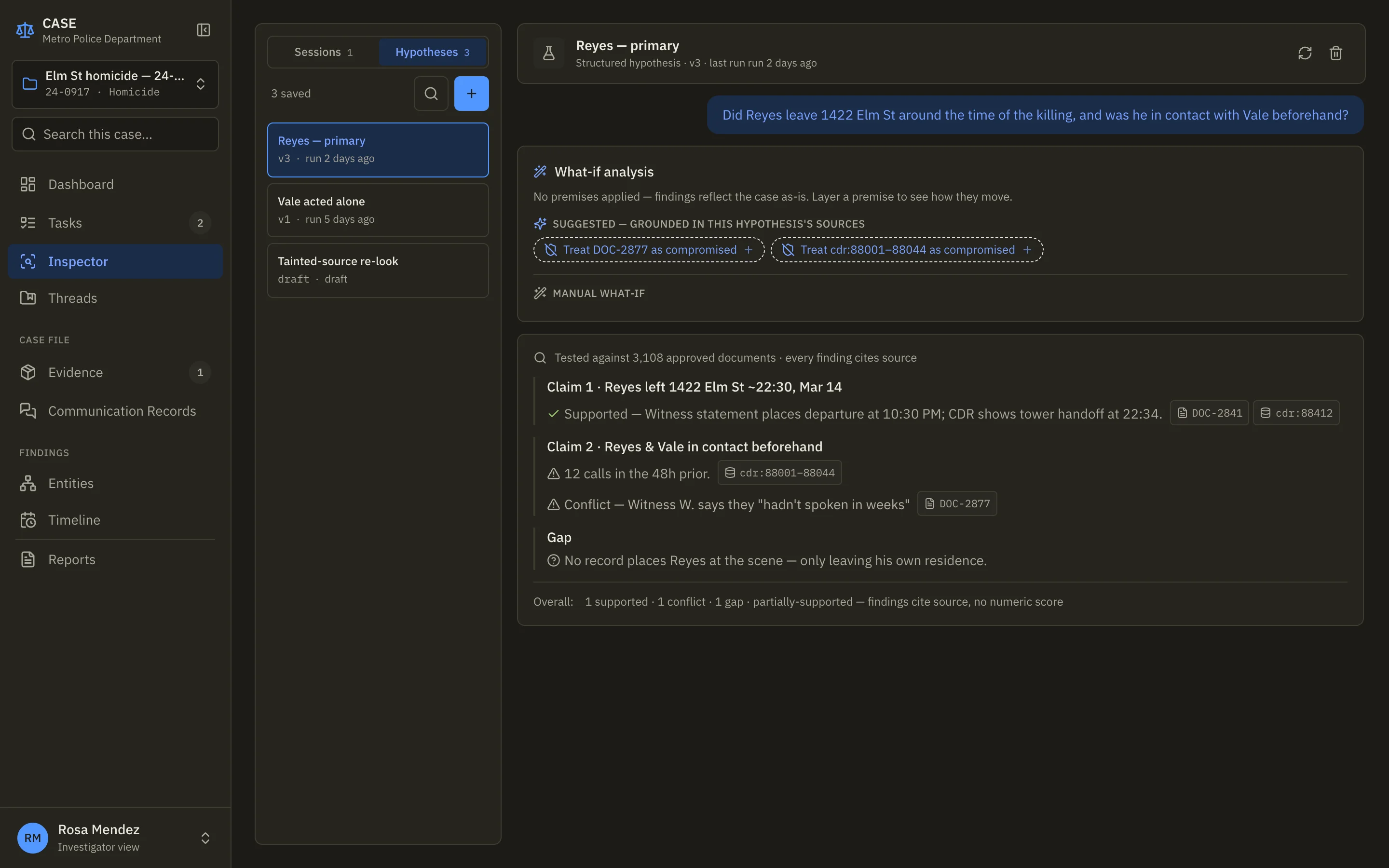
Each claim tested against the file.
- 4
What if.
A source is set aside.
TraceEvery entity, link and finding opens to the page it came from.
From first lead to closing argument.
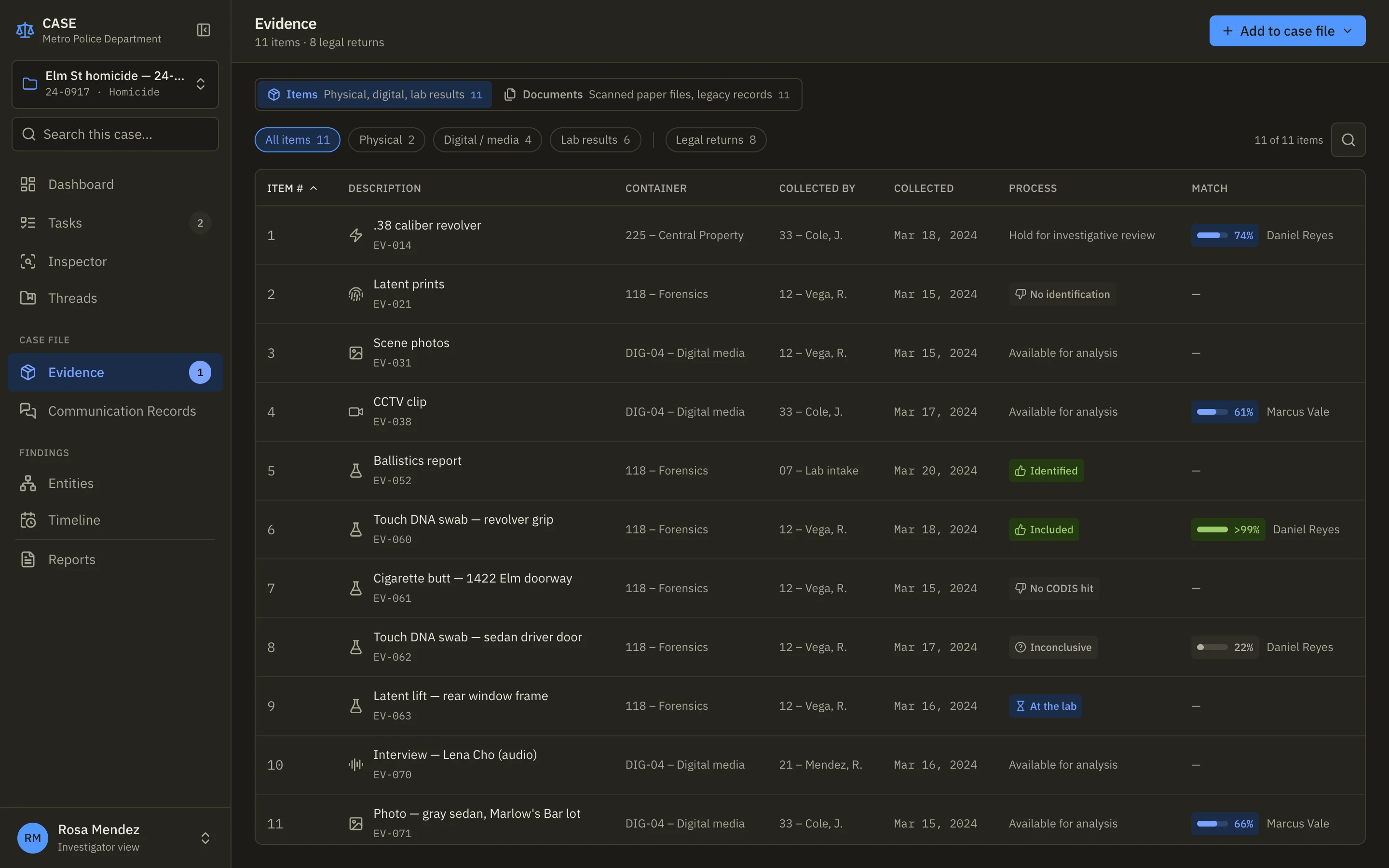
CASE isn't only where the evidence goes. It's where the case is run: opened from the initial report, worked lead by lead, and handed to the prosecutor in a package that stands up.
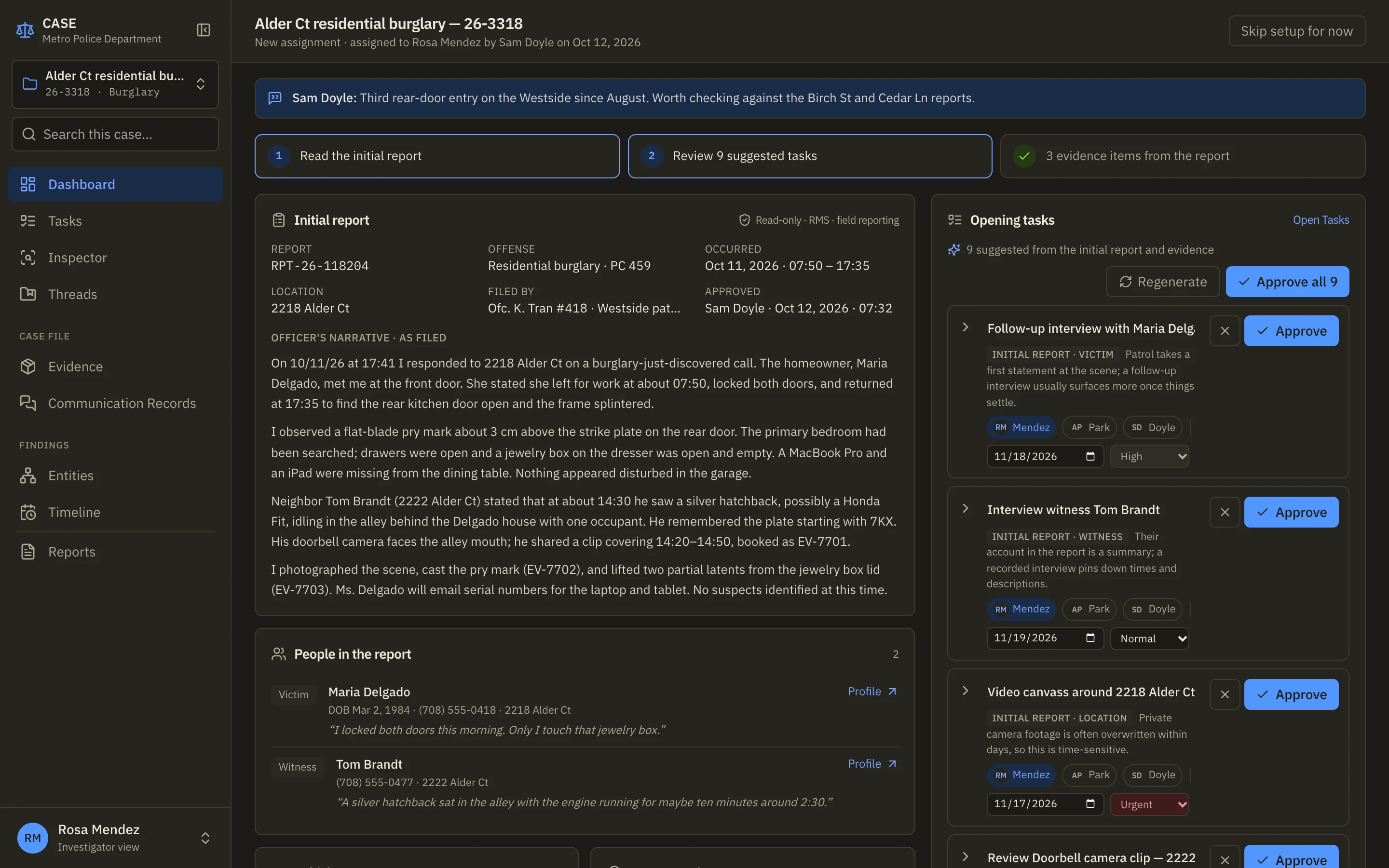
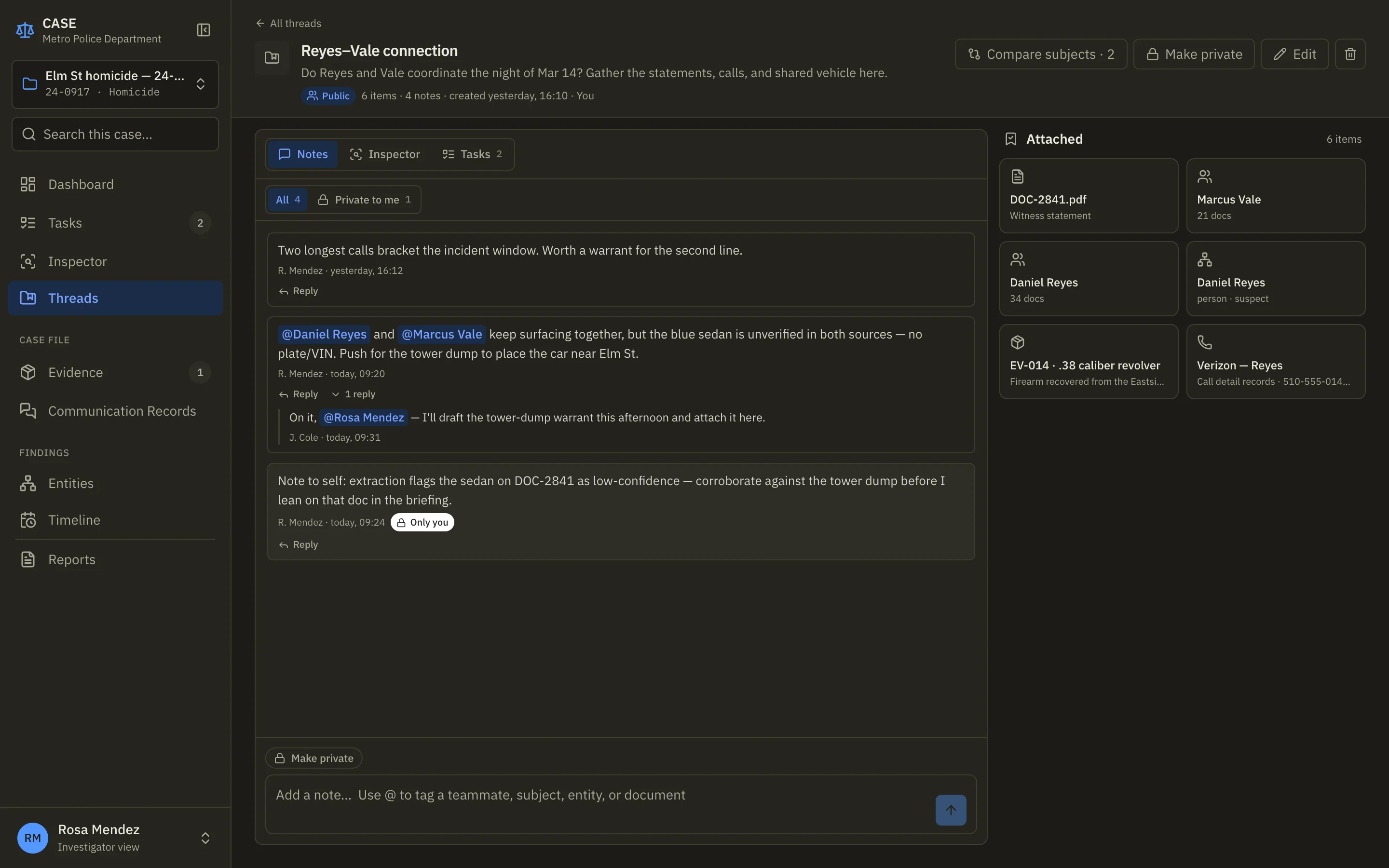
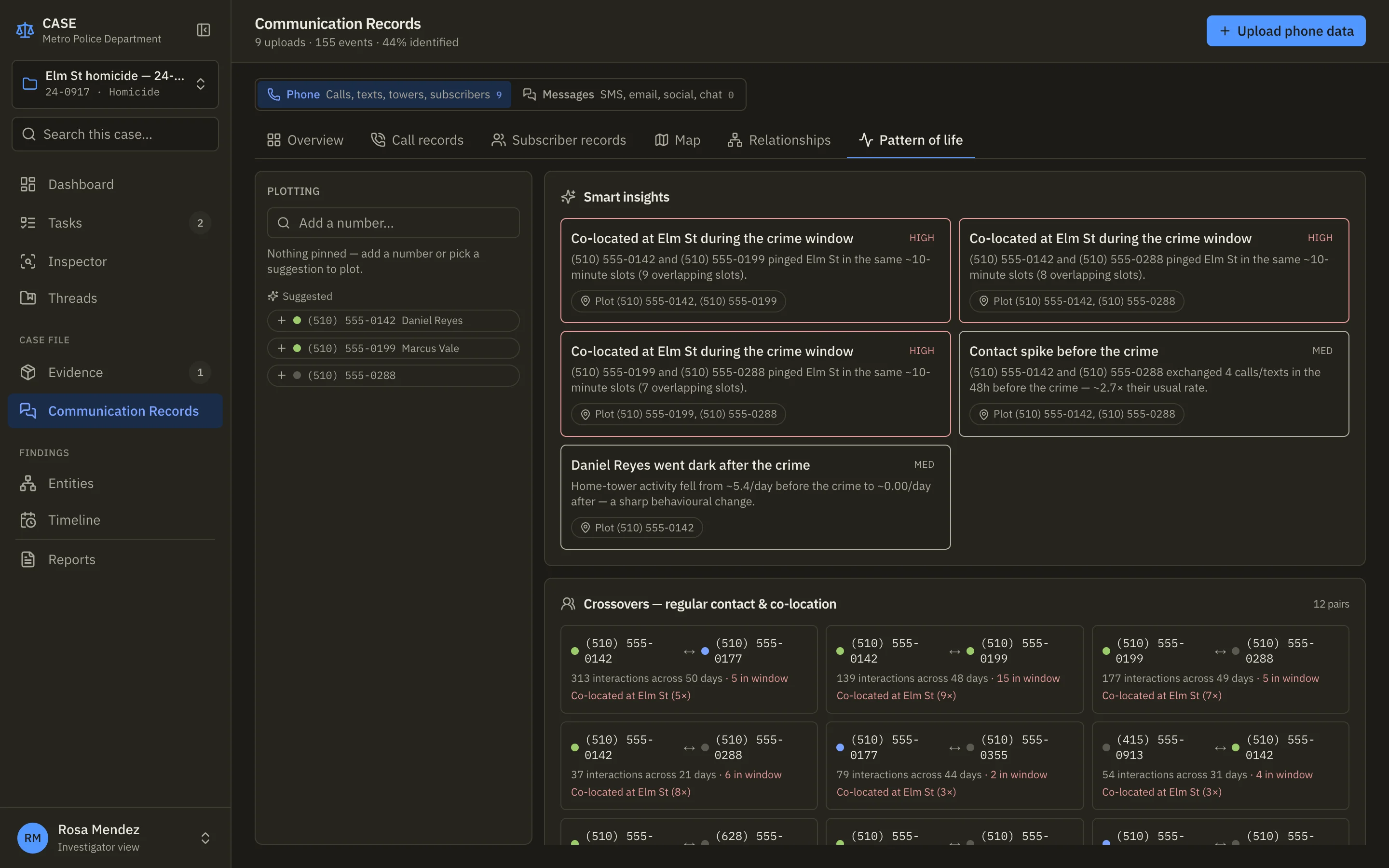
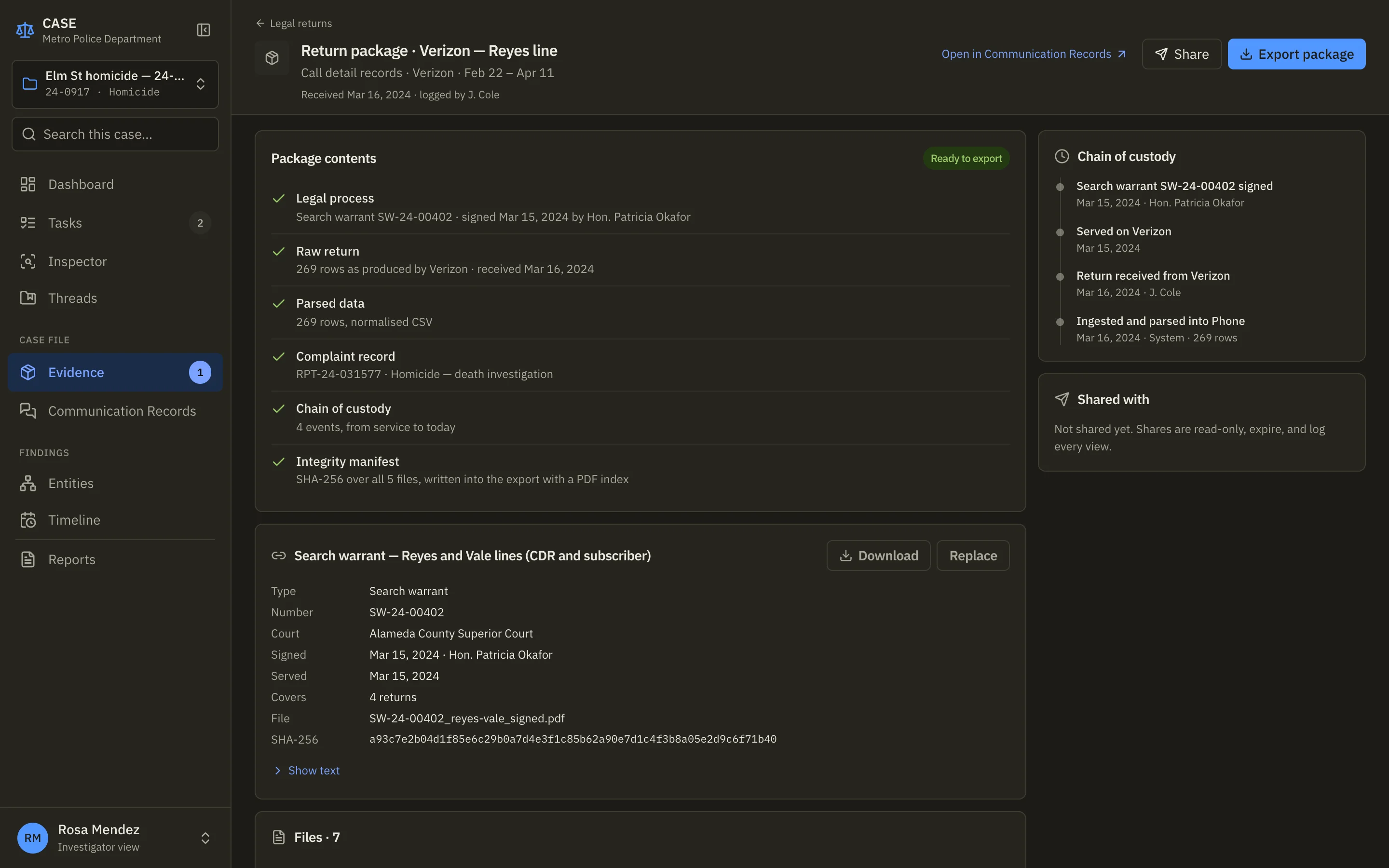
Use it on day one. Upload documents, phone returns, photos, video and spreadsheets as you go. When you're ready, CASE connects to your internal and third-party systems, so there's no waiting on an integration project to start.
Ask the case.
Inspector is an AI assistant that works only from the material your team has approved. Ask a question in plain language and every answer cites the page it came from. Test a theory and it shows what the evidence supports, what conflicts with it, and what's missing.
- What contradicts the witness's timeline?
- Which vehicles were seen near the scene?
- Where was this phone between 9 pm and midnight?
Who was in contact with 555-0142 on the night of the 14th?
Four numbers were in contact between 9:40 pm and 1:15 am. Two belong to known associates CDR 555-0142· p. 14. One is a prepaid line activated two days earlier Subscriber return· line 3.
The fourth number has no subscriber on file yet.
Everyone who works the case,
in one place.
Investigators
Start from the initial report, approve the opening tasks, work leads in threads, and ask Inspector for answers that cite the file.
Analysts
Bring in documents and returns, check what was extracted, and work tower dumps, call records and pattern of life across every number.
Reviewers
Often the case agent, an analyst or a supervisor. Approve or deny each document with a note; only approved material feeds search, entities, the timeline and Inspector.
Supervisors
See every investigator's open and overdue work across cases, set roles and permissions, and keep the department's document templates.
Every case you can see, and what needs you now.
Command center
Your caseload at a glance, with a brief grounded in the case files and the work waiting on you.
Search all cases
Find a name, phone or plate in any case in the department. Need-to-know still applies.
Team workload
See where cases are stuck: open, overdue and blocked tasks for each investigator, so work can be rebalanced.
Templates
Turn a warrant your court accepted into a template, then generate the next one from a case.
Every claim traces back to the evidence.
CASE doesn't generate conclusions. It structures, connects and surfaces what's already in the case material, and keeps the case clean while it does.
Reviewed
A reviewer approves or denies each document before it counts, and the decision and its note are kept.
Source-linked
Every entity, relationship, timeline event and finding cites the document or record it came from.
Need-to-know
People reach a case because they're assigned to it, and each role can do only what an administrator allows.
Append-only
Every change and review decision on a case is recorded in an audit trail that can't be edited.
Provenance kept
Third-party records stay labelled. Every value shows whether it came from the case, an outside source, or both.
Verifiable
Return packages carry their chain of custody and a SHA-256 manifest the prosecutor can check.
Infrastructure, not a chatbot.
Investigators see the case. Underneath it, CASE runs on Halō's engine: layers that turn raw material into source-linked output, with chain of custody, source linking and audit running through every one.
- 1
Sources
Everything the case brings in.
- 2
Engine
Read, reviewed and resolved.
- 3
The case
Who, what, where and when.
- 4
Interfaces and output
Timeline, Inspector, entities, reports.
Across every layerChain of custody, source linking and audit.
Not a blank canvas.
A tool that knows how a case works.
CASE starts from how a case actually works. It takes in the whole case, connects what's inside it, and reaches to known outside sources to widen the picture. The same structure holds across case types and grows to new ones without starting over.
Built with investigators, on real cases.
CASE is being built with the detectives and analysts who use it, on active cases in their precinct. What they need decides what gets built, from inside the work rather than from a team pitching to law enforcement.
That work has drawn attention from town, state and federal partners.
See CASE on a case like yours.
We'll walk your team through CASE on material that looks like your caseload, from the initial report to the package you hand the prosecutor.